
Anúncios
Have you ever stopped to consider that your talent might be the missing piece needed to create the next global hit? Many people believe that working in the gaming industry requires only programming skills, but the reality is far broader and more fascinating.
The gaming industry is currently experiencing an incredible period of expansion, offering opportunities for artists, writers, managers, and sound specialists. The gaming market is a vibrant ecosystem that values a diversity of skills and creative perspectives.
Anúncios
Today, we will explore various professional paths to help you determine the best direction for your career.
Professional paths for entering the gaming industry
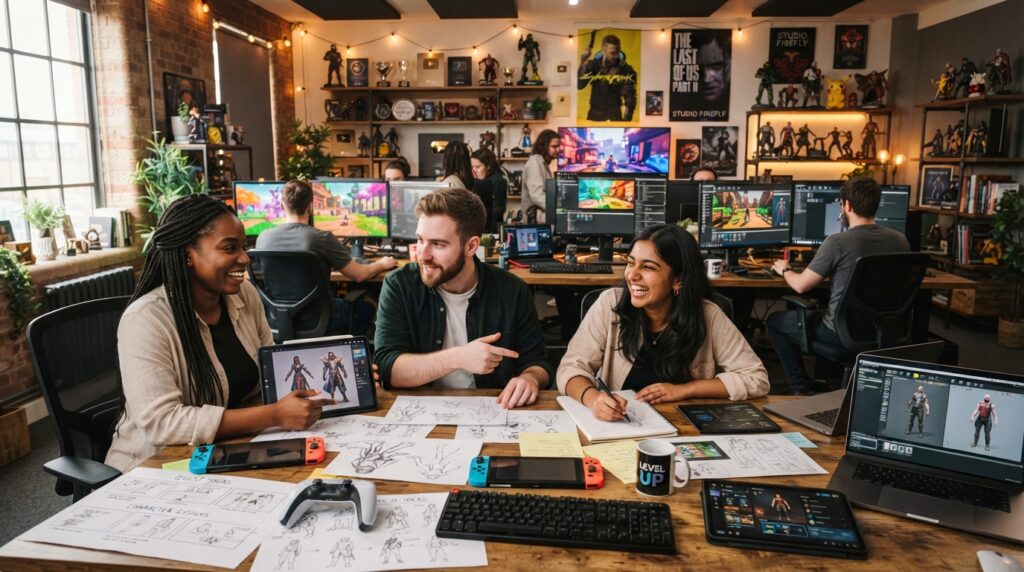
Have you ever wondered which of the five areas in the game industry best aligns with your skills? Starting a career in games is a process that requires self-awareness and a clear analysis of what you enjoy doing on a day-to-day basis.
There is no single formula for success, but understanding your natural aptitudes helps narrow down your options. Whether you lean toward the logic of programming or possess an artistic sensibility, the market has room for a wide range of talents.
Anúncios
How to choose an area that aligns with your interests and skills
The first step is to determine whether your profile is more technical, creative, or management-oriented. Those who enjoy solving complex problems often adapt well to software engineering.
On the other hand, individuals with an aptitude for visual tools or storytelling might find their place in art or design. Reflecting on what you already do as a hobby is an excellent starting point for defining your career path.
Why testing different roles can accelerate your professional discovery
Many beginners make the mistake of specializing too early, before understanding the full production workflow. Participating in small-scale projects—such as game jams—allows you to experiment with different roles in a collaborative environment.
By trying out various functions, you may discover affinities that wouldn’t be apparent through theory alone. This reduces uncertainty and helps you build a more robust portfolio, demonstrating versatility to potential employers.
Keep in mind that experimentation is a powerful learning tool. The more you explore, the sooner you will identify the specialization that truly makes sense for your professional future.
Game development: programming, engineering, and tools
The magic of games happens when logic meets art through well-structured systems. Game development is a vast discipline, where technical precision allows creative ideas to come to life on the player’s screen.
Gameplay programming and the creation of game mechanics
Gameplay programming focuses on the direct interaction between the user and the virtual world. This is where we define how a character jumps, how enemies react, or how items are collected.
The primary goal is to ensure the experience is responsive and fun. Developers in this field must translate abstract design concepts into functional code that adheres to the game’s rules.
Software engineering, systems, and performance
While gameplay handles interaction, software engineering focuses on the invisible structure that keeps everything running.
Professionals in this area work on system architecture, ensuring the game does not crash and performs well across different devices.
Optimization is a key part of this work. Maintaining a stable frame rate and managing memory usage are constant challenges that require a keen eye for technical performance.
Essential knowledge of C#, C++, Unity, and Unreal Engine
The industry utilizes a wide range of technologies, but some stand out due to their versatility and level of support. Choosing the right tool depends heavily on the type of project and the team’s objectives.
- Unity: Highly popular for its flexibility and use of the C# language; excellent for both 2D and 3D projects.
- Unreal Engine: Renowned for its high-end graphical performance and use of C++; ideal for large-scale productions.
- C#: An accessible language that facilitates rapid prototyping within modern game engines.
- C++: Offers complete control over hardware, making it essential for those seeking maximum performance.
How to get started with small, technically feasible projects
Don’t try to create the next big hit right out of the gate. Begin with simple projects—such as a basic platformer or a clone of a straightforward classic—to grasp the logic behind game programming.
Focusing on a smaller scope allows you to actually finish what you start. This is far more valuable for your learning process than having dozens of overly complex, unfinished projects.
What to include in a programming portfolio
Your portfolio should showcase not just the final result, but also how you solved problems. Include clean, well-commented code snippets that demonstrate your ability to organize systems.
Furthermore, explain the technical decisions you made during development. Showing that you understand the “why” behind every line of code is what truly impresses recruiters and game studios.
Game art: characters, environments, animation, and visual effects
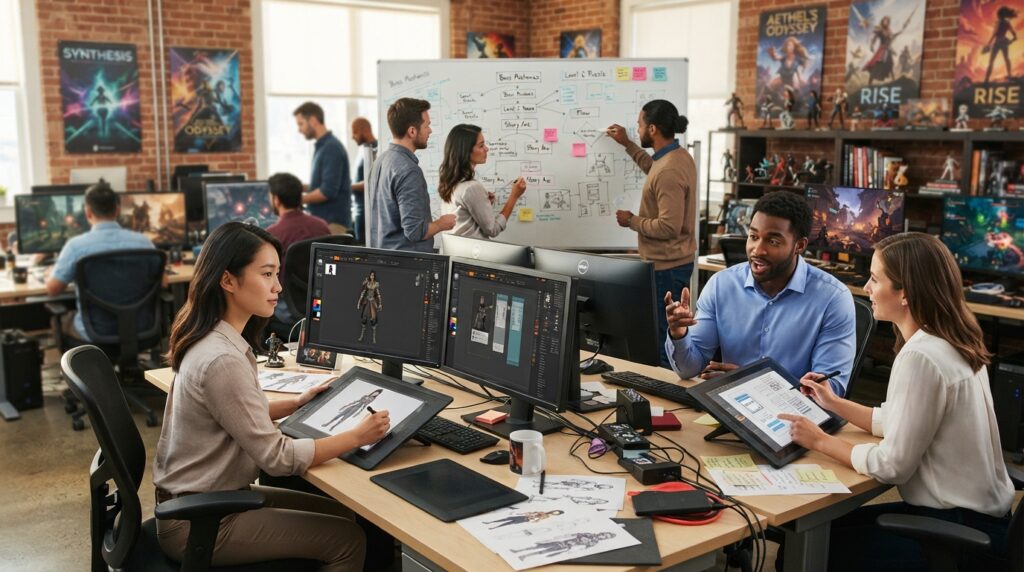
Transforming abstract ideas into tangible digital worlds requires a unique blend of technical skill and artistic sensibility. Game art defines a player’s first impression and sustains immersion throughout the entire experience.
Differences between 2D art, 3D modeling, and animation
2D art focuses on illustrations, concepts, and flat elements; it is essential for user interfaces and games with a stylized aesthetic. 3D modeling, by contrast, introduces depth, allowing characters and environments to gain volume and interact with light in a realistic way.
Animation is the link that brings these elements to life, defining how a character moves or how an environment reacts to its surroundings. Mastering these areas requires an understanding of both anatomy and the physics of motion.
Art direction and building a consistent visual identity
Art direction ensures that all visual elements “speak the same language,” creating a unique atmosphere for the game. Without a cohesive identity, a project can feel disjointed and fail to hold the audience’s attention.
A skilled art director balances colors, shapes, and lighting to guide the player’s gaze, ensuring that the visual style reinforces the game’s narrative and mechanics.
Tools used in professional production workflows
The industry relies on specific software to ensure efficiency and technical quality. Familiarity with these tools serves as a competitive advantage for anyone seeking a position in the field.
- Adobe Photoshop and Illustrator for 2D art and texturing.
- Blender, Maya, or ZBrush for advanced 3D modeling.
- Unity or Unreal Engine for visual integration.
- Substance Painter for creating realistic materials.
How to build a visual portfolio, even without studio experience
You don’t need a formal job to start building your portfolio. Focus on creating personal projects that demonstrate your ability to solve specific visual problems.
Choose a theme, define a style, and produce pieces that showcase your versatility. What matters is that the final material reflects both your technical mastery and your creative vision.
Why showing your process can be just as important as the final result
Studios value professionals who can explain their technical decisions. Sharing sketches, references, and intermediate versions reveals how you handle challenges and evolve throughout the creative process.
By documenting your workflow, you demonstrate an organized approach—instilling confidence in recruiters and showing that you are ready to join a professional team.
Game design: creating fun and intuitive experiences
Game design is the soul of any project, transforming abstract ideas into interactive experiences. This field requires a unique blend of creativity and logic to ensure the player remains engaged from start to finish.
The role of the game designer in defining rules and objectives
A game designer acts as the architect of fun. They define the core rules, the objectives the player must achieve, and the rewards that keep interest alive.
Without a clear set of guidelines, a game can become confusing or frustrating. The designer must ensure that every mechanic serves a purpose within the created universe.
Level design, progression, and difficulty balancing
Level design is essential for guiding the player through their journey; it organizes space and time, ensuring that challenges increase in a gradual and natural way.
A well-balanced difficulty level prevents users from giving up due to boredom or excessive complexity. Progression should feel like a continuous achievement, where new skills are tested across a variety of scenarios.
Player research and testing to improve the experience
Public opinion is the most important barometer for any studio. Conducting hands-on testing helps identify flaws that wouldn’t be apparent on paper alone.
Observing how people interact with the system helps fine-tune the pacing and the clarity of instructions. Qualitative feedback is a powerful tool for refining the final experience.
How to turn an idea into a playable prototype
A prototype is the simplest version of an idea, focusing solely on the core mechanics. The goal here isn’t visual polish, but rather to validate whether the interaction is actually fun.
Using rapid prototyping tools allows for the testing of concepts in just a few days, saving time and resources before full-scale production begins.
Metrics and observations for evaluating a prototype
When evaluating a prototype, focus on simple metrics such as retention time and ease of learning. Observe whether the player understands what to do without needing external explanations.
Noting moments where a player hesitates or frequently makes mistakes provides valuable clues. These direct observations are essential to the long-term success of game design and level design.
Conclusion
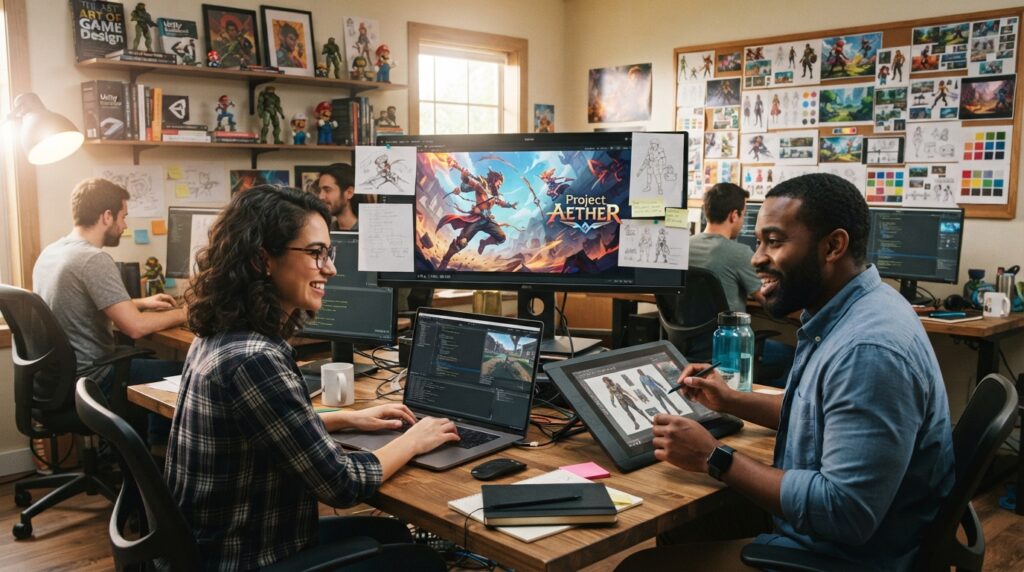
The gaming industry offers a vast universe for those who wish to turn their passion into a profession. Success in this sector depends less on luck and much more on a solid foundation built through constant practice and technical curiosity.
Your journey begins with simple actions that yield significant results. Choose a game engine—such as Unity or Unreal Engine—and dedicate time to understanding its tools.
Review your current projects and select your best work to build your portfolio. Explain your technical choices and the reasoning behind each mechanic or piece of art you’ve created. Studios value professionals who demonstrate a clear understanding of their own learning process.